fine art project archive: Lightside Photographic Services offers the complete service of overseeing and organizing all stages of processing, printing and presentation Our clients include photographers, artists, galleries, museums, art consultants, curators and collectors who need their photography expertly prepared for exhibition, reproduction or sale.
Subscribe to RSS feed
Shocking pink
Richard Mosse, 2011
(scroll down for more images)
written by Jason Stearns
Re-posted from: www.guardian.uk.co / Saturday 28 May 2011
Reports on Congo focus on bleak statistics: 5.4 million deaths, 400,000 rapes. Richard Mosse uses infrared film to show the country in a different light
Imagine 5.4 million deaths. It overloads the mind. There is no sliding scale of moral outrage, increasing in direct proportion to human suffering. The indignation we feel at 10 innocent deaths is not magnified 10 times if there are 100 such fatalities. Instead, our heartstrings are more likely to be tugged by a human face, a tragic story.
This has been the curse of the war in the Democratic Republic of the Congo. It’s too complex to craft into a simple narrative. Over the past 15 years, more than 40 different armed groups have fought across a country the size of western Europe. There are no clear heroes and too many villains, no good-guy-v-bad-guy tale to spin. While the number of people who have died is on the same scale as the Cambodian and Rwandan genocides, only around 300,000 were killed; the rest – disproportionately children – perished unsensationally due to disease and hunger caused by the fighting.
Bereft of a clear narrative, journalists and photographers often confine themselves to stories of suffering, anchored in bleak statistics: 400,000 rapes in one year; 5.4 million deaths between 1998 and 2007.
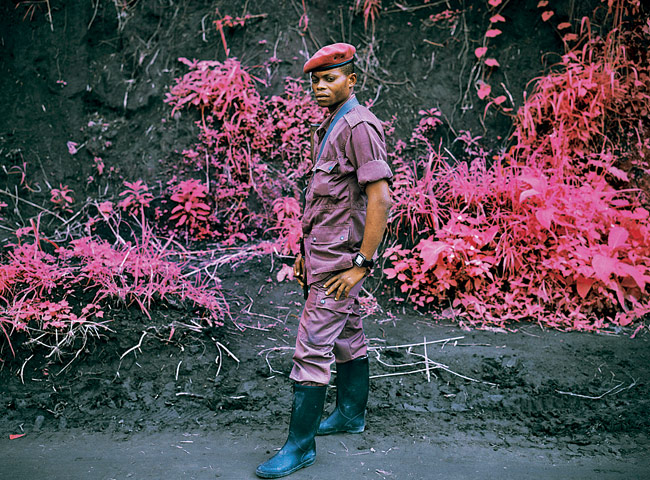
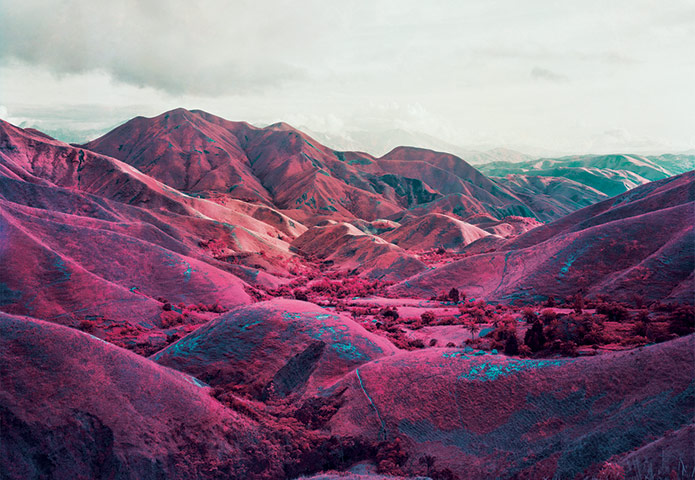
Richard Mosse’s pictures of Congo draw from a different palette of colours, literally. Using recently discontinued Kodak infrared film, his photographs turn the vegetation of the eastern Congo into jarring magenta, while the soldiers’ uniforms go purple. It feels as if we have fallen down a rabbit hole, into a more surreal space. Congo always felt that way to me, as if the regular colour spectrum, the usual yardsticks we have, do not quite hack it.
This Aerochrome infrared film was developed by the US military in the 1940s to detect camouflage and to reveal part of the spectrum of light the human eye cannot see. But where this technology was invented to detect enemy positions in the underbrush, Mosse uses it to make us call into question pictures we thought we understood. These are the images we take for granted from Congo: the ruthless militia commander, the rape victim, an unwitting peasant. But in Mosse’s pictures, Congo’s photographic clichés are represented in a counterpoint of electric pink, teal blue and lavender. By representing the conflict with an invisible spectrum of infrared light, he pushes us to see this tragedy in new ways.
This sequence of pictures depicts the integration of rebels from the National Congress for the Defence of the People (CNDP) into the Congolese national army in 2010. The CNDP is probably the best example of the failings of the Congolese peace process. In 2002, all major Congolese belligerents signed a peace deal that brought to an end a series of wars that had begun in 1996. They formed a transitional government and army that led to elections in 2006, which were won by the current president, Joseph Kabila.
Not all parties were well served by the elections. The Congolese Rally for Democracy armed group that controlled the eastern third of this vast country, including the rolling highlands depicted here, won only a tiny percentage of the vote. These rebels felt the elections jeopardised their political interests as well as the security of the Tutsi community. Throughout the war, this small community suffered vicious persecution, but its members have also been protagonists in some of the worst bouts of violence.
Thus a new rebellion, the CNDP, was born, and the eastern Congo was plunged again into deadly fighting. Here is another reading of Mosse’s purple tincture – the CNDP was launched, to a certain extent, out of a sentiment of sour grapes. The leaders of the rebellion wanted to obtain through armed force what they were not able to gain through the ballot box. They justified their insurrection through self-defence, saying their community was in danger.
This rhetoric of victimhood became a self-fulfilling prophecy. Their insurrection sparked a dozen counter-rebellions, turning a swath of eastern Congo – an area roughly the size of England – into a battlefield. The CNDP received support from neighbouring Rwanda, where the government had ethnic and economic ties to the rebellion, while the Congolese government pumped weapons and money into the other militias.
This proxy war displaced more than 1 million people and killed thousands. New surveys suggest that more than 100,000 women were raped in this area in 2006 alone. Thousands of people were killed.
The pictures here show the uneasy truce that has brought an end to some of the fighting. In 2009, the Congolese and Rwandan governments concluded a secretive peace deal that prompted the integration of the CNDP into the Congolese army. The agreement is shaky, because the army is too weak to force a full-fledged integration. So the CNDP today forms an army within an army, maintaining many of their old positions as well as expanding their control to mineral-rich areas. Such has often been the logic of peacemaking in Congo: if you can’t beat them, buy them off. The population of eastern Congo is understandably skeptical.
And yet, with elections scheduled for later this year, the international community has begun to scale down operations. The EU is retiring its special envoy to the region and the UN peacekeeping mission is also under pressure to downsize.
Several years ago, I went to interview a militia commander in the eastern highlands. He was as close as you can get to a stereotype of a Congolese warlord: around his neck he wore an amulet of cowries, colonial-era coins and monkey skulls. When we started talking, however, he was articulate and gave me a host of reasons – some reasonable, some not – for why he was fighting.
When I asked if I could take his picture, he shook his head. “You’re going to take my picture to Europe and show it to other white people. What do they know about my life?” He said they would think he was some kind of macaque, a forest monkey.
He was not altogether wrong. All too often we have reduced the conflict in Congo to a spectacle of crazed warlords and greedy politicians. That imagery can prompt us to ascribe the suffering to some inscrutable savagery and throw up our hands in despair. But there is much more to Congo than that, and Mosse’s approach makes us look again, and look closer suggests we apply these infrared lenses to Congo’s politics, as well, to look slightly beneath the surface to understand the actors and their motivations.
Note: LTI-Lightside has been processing film for Richard Mosse since 2009.
Richard Mosse, 2011
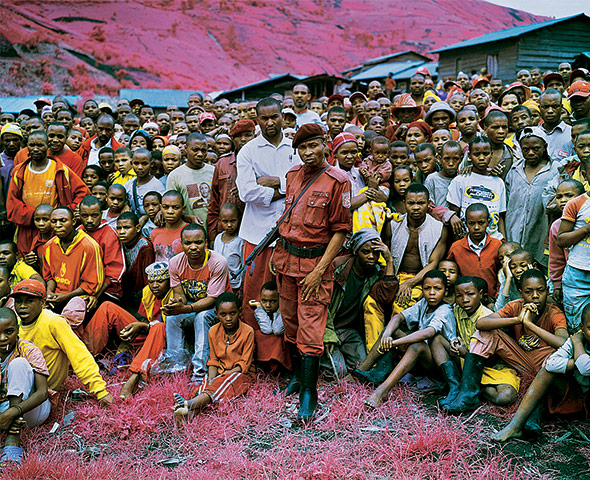
Richard Mosse, 2011
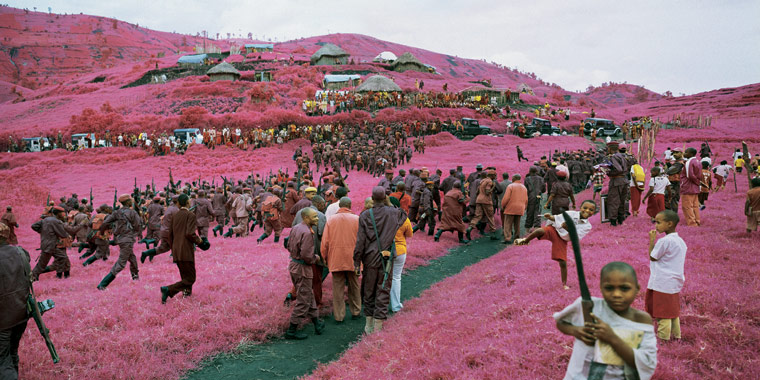
Richard Mosse, 2011
Tags: Film Processing, Richard Mosse
Moveable Feast: Fresh Produce and the NYC Green Cart Program
Museum of the City of New York
Mar 22 through Jul 10, 2011
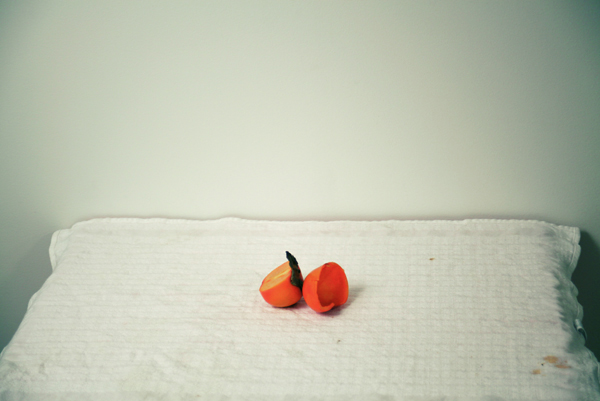
Shen Wei: Half Persimmon, 2009
30 x 40 archival pigment print
Moveable Feast: Fresh Produce and the NYC Green Cart Program documents an innovative NYC Department of Health and Mental Hygiene program that provides underserved communities with access to fresh fruits and vegetables via hundreds of independently owned, mobile produce stands known as Green Carts.
The exhibition features new photographs by LaToya Ruby Frazier, Thomas Holton, Gabriele Stabile, Will Steacy, and Shen Wei, who were commissioned by the Aperture Foundation to chronicle the initiative over the course of a year.
The resulting photographs, in styles ranging from portraiture to landscape to street photography, capture not only the carts themselves, but also the stories of the vendors, customers, and their communities.
Moveable Feast invites consideration about the geography of food options and its relationship to a community’s health.
LTI-Lightside worked with Aperture Foundation to produce prints for Gabriel Stabile, LaToya Ruby Frazier and Shen Wei for this exhibition.
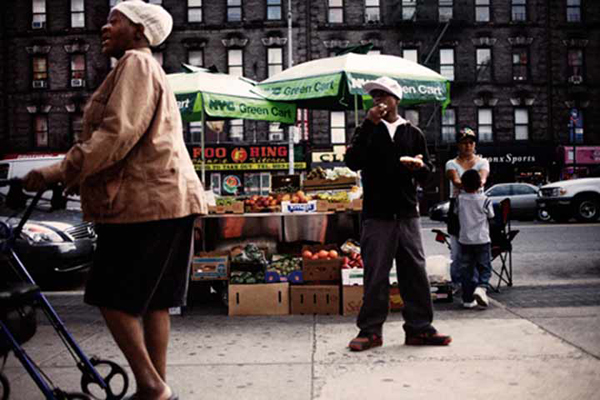
Gabriele Stabile: From the series Street Smart, 2009
11 x 14 digital c-print
Tags: Aperture Foundation, Archival Pigment Printing (Inkjet), Digital-C Printing, Exhibitions
As always, there are a ton of openings on any given Thursday evening in New York City … and we’ve spent the past few weeks simultaneously working our way through two exhibitions that open tomorrow night. Both were pretty straight-forward projects involving the usual mix of services: silver gelatin b+w, archival pigment printing, digital and conventional c-print, and some mounting and framing … the funny part (to us, anyway) was how worlds-apart the work felt .. or at least in this case, a half a world apart, literally.
And although these artists will likely never be exhibited side-by-side in the same gallery, this post might at least give you a sense of how weird it is for us to be surrounded by say, a still youngish Keith Richards making breakfast in 1975 next to a derelict band of CBeebies living under a bridge in the middle of China somewhere …
Cao Fei, meet Ken Regan … Ken, Cao Fei.
Ken Regan
Morrison Hotel Gallery
May – June, 2011
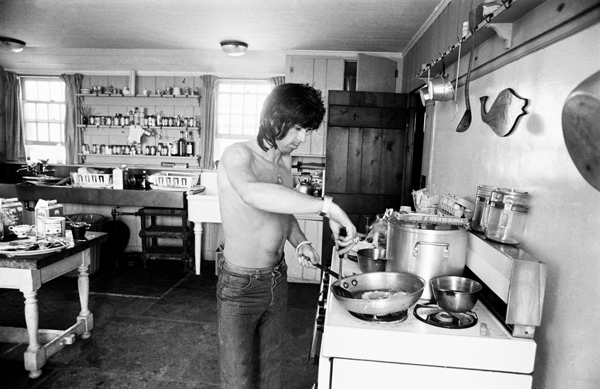
Ken Regan: Keith Richards Making Breakfast, Montauk, NY, 1975
30″ x 40″ archival pigment print
Playtime
Cao Fei
Lombard Freid Projects
May 19 – June 25, 2011
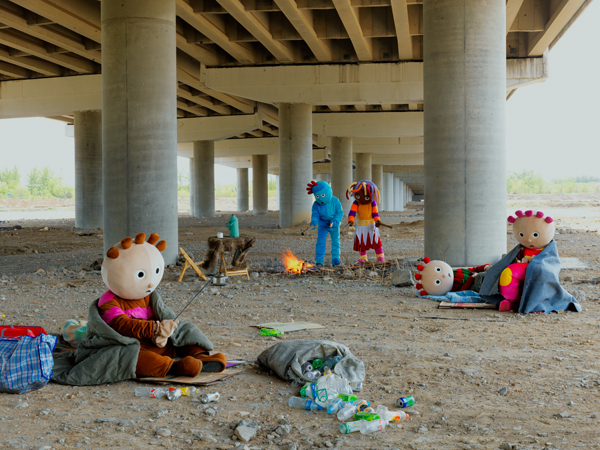
Cao Fei: After a Long Day (Post Garden, Eye-SPY Photo Series), 2011
60cm x 80cm digital c-print, dibond mount, maple frame
Tags: B+W Silver Gelatin Printing, Cao Fei, Digital-C Printing, Exhibitions, Framing, Ken Regan, Lombard-Freid Projects, Morrison Hotel Gallery, Mounting
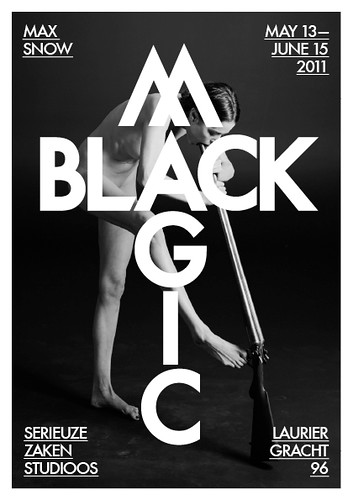
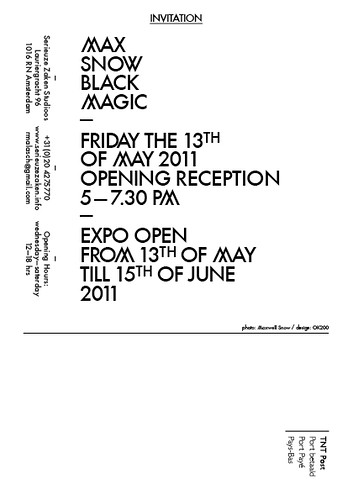
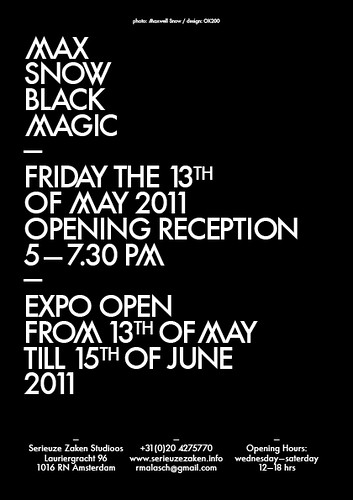
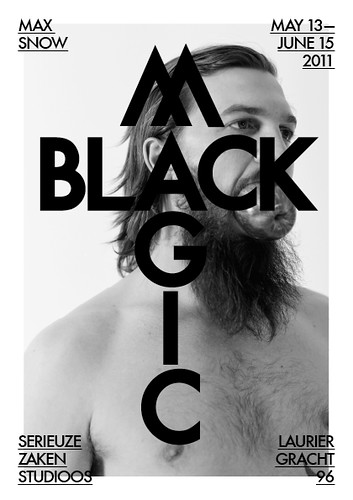
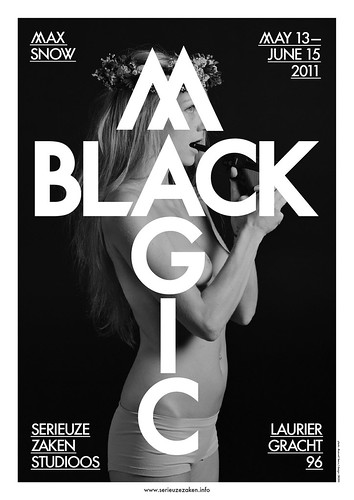
The following is a re-post from what I’m guessing must be the the Serieuze Zaken Studioo’s blog announcement for Max Snow’s exhibition Black Magic, which opens this Saturday, May 13 in Amsterdam. If you noodle through the links you can see the posters and the FaceBook page link, etc. … obviously, most of it is in Dutch … but if you happen to be there this weekend, I would expect this to be quite a scene.
We’ve recently helped Max out with a bunch of stuff: 8 x 10 film processing, hi res scanning, retouching, printing and mounting … some of it should be in Amsterdam and he has more going up in Berlin soon as well.
Will keep you posted.
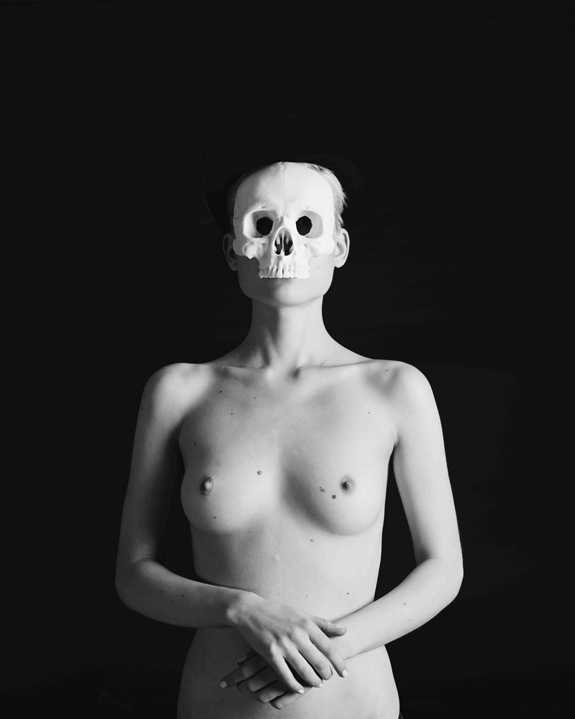
Max Snow
24 x 30 archival pigment print
3mm dibond
Tags: Archival Pigment Printing (Inkjet), Exhibitions, Max Snow, Mounting
Form Forming Formation
David Benjamin Sherry
OH WOW Gallery
April 30 – May 27. 2011
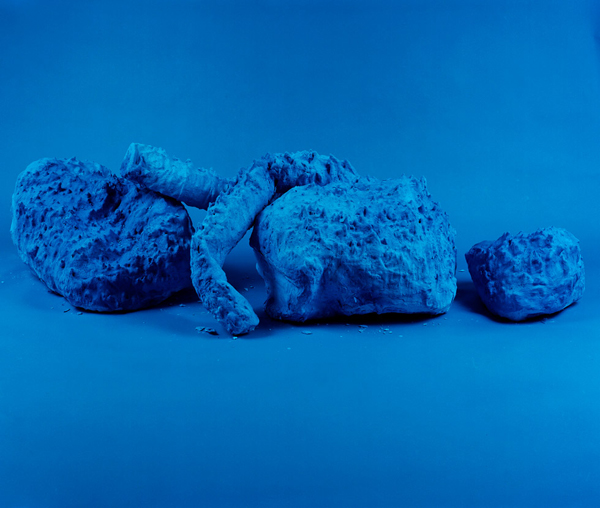
David Benjamin Sherry Royal Ruin Ultramarine Umbilical Fiend Fallen Cobalt Core, 2011
50 x 60 optical c-print
We’re pleased to have produced 11 prints for David Benjamin Sherry’s newest body of work this past month: Form Forming Formation. Sherry has certainly been on roll this past year with his work being exhibitied in numerous shows (see our April 13th post: David Benjamin Sherry Gets the Nod, 5 Art Stars You Need To Know, re-posted from The L / online).
In Form Forming Formation, Sherry studies concepts of geometry, science, color, materiality and the course of change. This exhibition includes both traditional color prints and photographic collage work. Read the press release here.
If you’re in Los Angeles, you should take a look …
Tags: Conventional C-Printing, David Benjamin Sherry, Exhibitions, Film Processing, OH WOW Gallery
The following story is from re-posted from the The Hindu.com. Nicholas Vreeland’s exhibition Return to the Roof of the World opens at the Leica Gallery, 670 Broadway on Wednesday, April 20th, 6 – 8 pm
The Monk with a Camera
SHAILAJA TRIPATHI

Nicholas Vreeland
American Buddhist monk Nicholas Vreeland is showcasing his photographs to raise funds for the reconstruction of Rato Dratsang monastery.
Very few people are as lucky as Nicholas Vreeland, getting to channel their passion towards their conviction. Born with an innate sense of identifying a moment, strengthened further by an academic pursuit, Vreeland is putting his talent to use for the cause he has believed in for the past 25 years. The monk is trying to raise money to build Rato Dratsang monastery in Karnataka through the sale of his 20 photographs in the exhibition “Photos For Rato”.
14th Century monastery
Rato Dratsang monastery was founded in the 14th Century for studying Buddhist logic. In 1983, a few Rato monks fled to India to escape the Chinese invasion of Tibet. They built a two-storey building in Mundgod near Hubli in Karnataka and began to live there. From 12, the number of monks has increased to 120, fuelling the need for a bigger space.
Every month the centre for learning also receives scholar monks from Tibet, who stay in the monastery as guests. About four monks share a room and the temple is a temporary shelter under an asbestos roof. Now, the dream to expand the monastery to 66 monks’ rooms, administration building, plus a kitchen and a dining area is being realised with the sale of pictures taken by Vreeland, who co-founded Rato Dratsang Foundation, over two decades ago.
“With the economic collapse in 2008, all our sponsors and funds disappeared and we thought of this idea,” says the Buddhist monk.
But the Swiss-born Vreeland is not a hobby photographer. A protégé of Henri Cartier-Bresson, he even went to NYU’s film school and has photographed maharajas and Tibetan Rinpoches, has edited “An Open Heart” by the Dalai Lama, on the New York Times bestseller list. His life-size portrait of the Dalai Lama was hung as a billboard all over New York during the Buddhist spiritual leader’s visit to the city in 2003.
“I picked up photography when I was 13, and it carried me through my school and it was because of this passion that I decided to join a film school. But I came to the monastery (Rato Dratsang) without a camera. My family later gave it to me,” recalls Nicholas, grandson of fashion icon Diana Vreeland and son of an American ambassador who also worked as an assistant to Irving Penn.
The important lesson he learnt from his myriad experiences, and probably from Buddhism, is abundantly at play here. Most of the images have been taken inside the monastery for he believes, “The more intimate a photographer is to his subject, the more profound his picture will be. So, I tried to take pictures in my room and didn’t venture out as much though there are street pictures like a bull sitting against a film poster.”
Careful not to operate like a photo-journalist, Nicholas, says, he never tried to capture everything and anything. “I kept the camera locked in a box and slowly started doing portraits of the monks against the white wall which got beautiful sunlight. Then it became more frequent. But I only take pictures when I feel comfortable in an environment,” says Nicholas.
The side profile of a monk reading in his room, he feels, is very personal and not something a street photographer can click. “I was in the room talking to his teacher and clicked it. A street photographer will not have access to this world,” says Nicholas who is showcasing this collection in Chicago, Paris, London, Rome and Berlin to gather financial support. The photographs can be seen at www.dratsangfoundation.org where people can also give donations online.
Tags: Leica Gallery, Nicholas Vreeland
Reposted from The L online. Read the entire article here
#5 DAVID BENJAMIN SHERRY
2010 was a big year for the Long Island-born, Woodstock-raised, New York-based photographer David Benjamin Sherry: after being featured in over 20 group exhibitions throughout the city since 2006, when he entered Yale’s MFA program, he not only made a strong impression in MoMA PS1’s quinquennial emerging artists-vetting salon Greater New York, but had his stateside solo debut (after shows in Berlin and Vienna) at East Hampton’s trendy non-profit gallery The Fireplace Project. He dabbles in fashion photography—shooting for I-D, Another Man and others—which makes sense given the beautiful young, naked bodies populating the technicolor landscapes in many of his fine-art photos.
Sherry is a die-hard analog purist in the age of digital manipulation, which wouldn’t be so astounding if his carefully staged photos didn’t emerge from the darkroom with dazzling palettes, abstract mirroring effects and unnatural monochrome tints. He makes plentiful use of makeup, as in the self-portrait “Blueballs” (2010)—his bust completely covered in royal blue with a matching backdrop and gag-ball clutched in his mouth—which might have been a porny parody of the Blue Man Group if not for the vulnerable look in his light-blue eyes. In “Wake Me Up On Oh Phenomena” (2010) he lies naked face down on a cliff, covered entirely in yellowish-orange makeup so that he nearly blends into the rocks under a surreally blue sky.
SLIDESHOW: 20 NYC Art Stars, When They Were Young!
Much of his work has a genuine and revelatory tone undercutting the lush colors and often spectacular locations. Sherry’s outdoor shots are mostly taken on road trips—more spartan and quasi-spiritual than Ryan McGinley‘s, more personal than Ansel Adams‘s—especially to national parks. His studio-based works allow him to incorporate his sculptures, which are similarly playful while being neither pretentious nor flippant. This year he’s showing work in Aspen, Rome and Moscow, affording him many more road trips as we await his solo debut in New York.
Slideshow

5 Art Stars You Need to Know: David Benjamin Sherry
Images courtesy the artist.
Tags: David Benjamin Sherry, The L Magazine
The Wild Heart
MIss Sunny Suits
Daniel Reich Gallery
April 2 – May 14, 2011
We had the pleasure of printing Sunny Suits’ exhibition at Daniel Reich Gallery this month. There are over 60 images in this show, a wide mix of Suits style. If you don’t know the work or the context, I suggest to stop by as it’s well worth a trip to Chelsea. At the very least check out the links to the press below.
All images Sunny Suits from The Wild Heart
Left to Right / Top to Bottom
Ian Rowing in Central Park, NYC 2001
Walt On My Floor, Paris, 2006
Blue, Self Portrait, Lisbon, 2006
Lawrence (petite mort), Paris, 2010
Georgie in the Toilets, Niagara, 2008
Tags: Daniel Reich Gallery, Exhibitions, Sunny Suits
Nudes and Revolutions
Sebastiaan Bemer
Edwynn Houk Gallery
March 3 – April 23, 2001
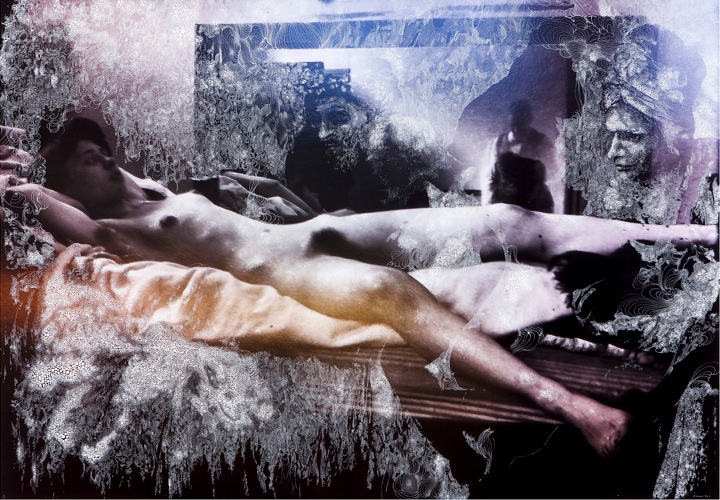
Sebastiaan Bremer, Susanna Surprised by the Elders, 2001
44″ x 64″ Digital C-Print with Inks and Acrylics
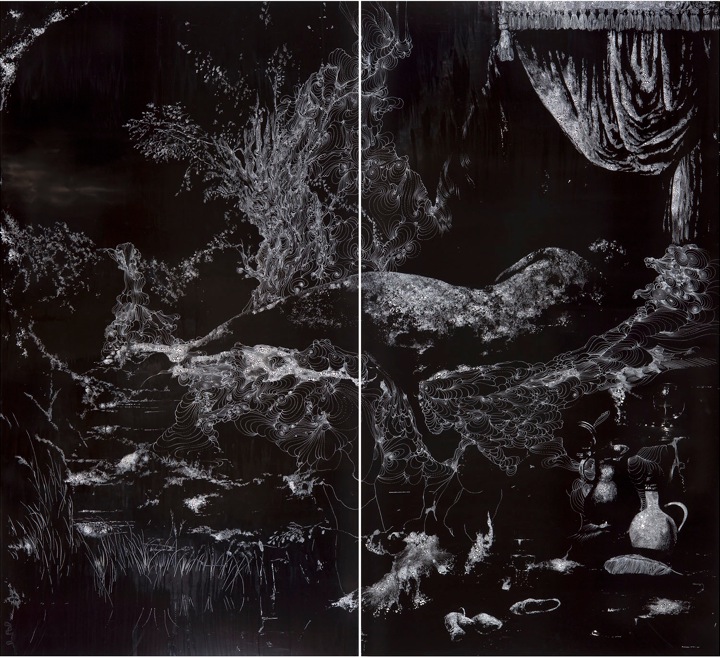
Sebastiaan Bremer, Waterfall, 2008-2001
Digital C-Prints with Inks and Acrylics
75″ x 83″ overall / each panel: 75″ x 41.5″
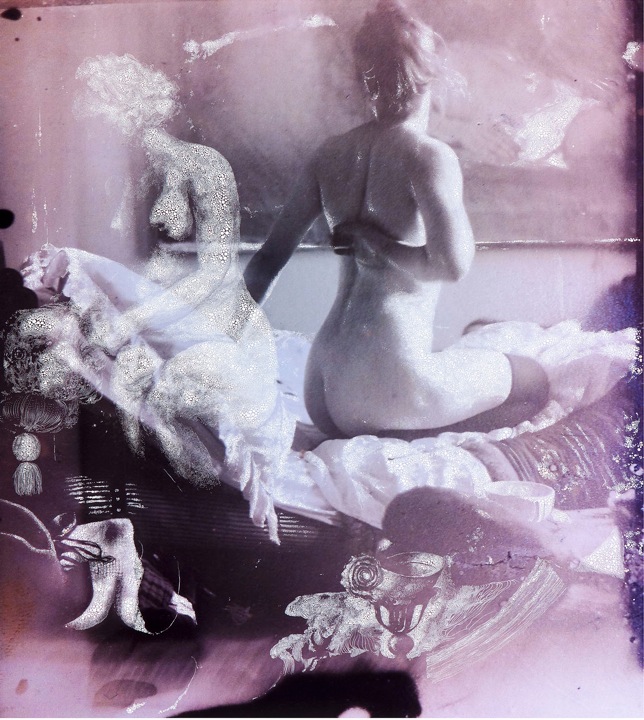
Sebastiaan Bremer, Judith’s Anatomy Lesson, 2011
48″ x 43″ Digital C-Print with Inks and Acrylics
Tags: Digital-C Printing, Edwynn Houk Gallery, Exhibitions, Sebastiaan Bremer
Cities
Sze Tsung Leong
Yossi Milo
February 17 – April 2, 2011
Opening tonight at Yossi Milo Gallery, Sze Tsung Leong shows images from his project, Cities. Leong began shooting for Cities back in in 2002, which, makes our involvement with the work seem like a blip on the time map … but really, we’ve been printing full editions of these things for over two years now and might possibly be just as excited about seeing them up as he is …
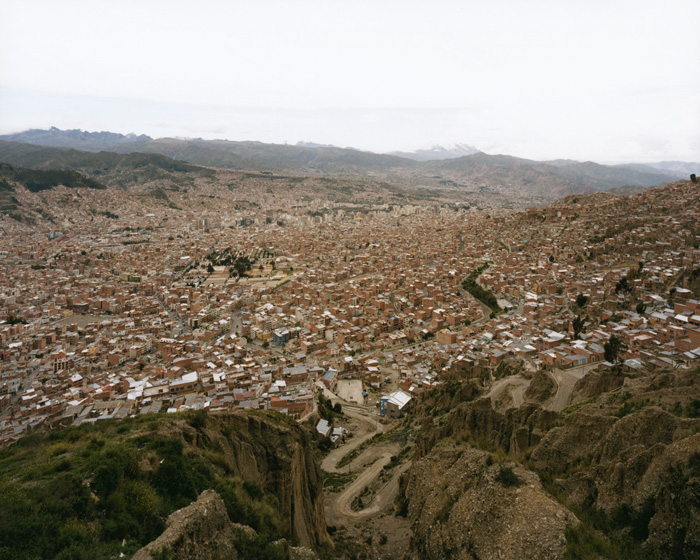
Sze Tsung Leong: La Paz, 2009, from the series Cities
48 x 60 optical chromogenic color print
You can read more about Leong and Cities by clicking this link.
Tags: Conventional C-Printing, Exhibitions, Film Processing, Sze Tsung Leong, Yossi Milo Gallery